Solar Film Tester Parameter Interpretation Guide: An Easy-to-Understand Professional Data Manual
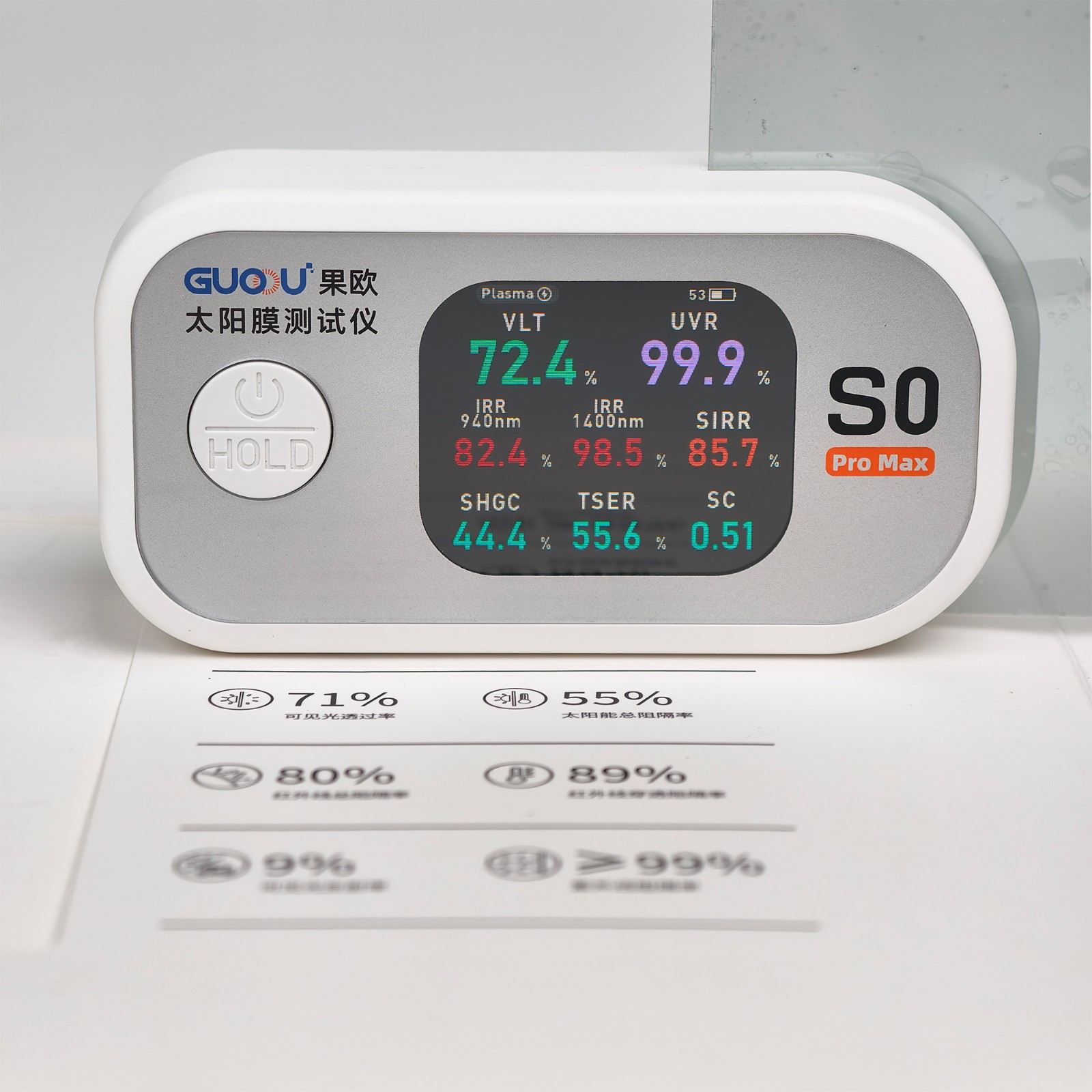
When choosing solar film or verifying tinting quality, the parameters of a solar film tester are the core basis for judging performance. However, facing a series of professional abbreviations such as VLT, UVR, IRR, and SIRR, many people feel confused—what exactly do these parameters mean? What does a high or low value indicate? This article will take the GUOOU S0 Series Solar Film Tester as a reference, explain each key parameter in plain language, allowing you to easily understand the test data and avoid pitfalls when choosing film!
I. Detailed Explanation of Core Parameters: The Key Meaning Behind Each Letter
1. VLT (Visible Light Transmission Rate)
(1) Definition: Measures the proportion of visible light (380~780nm band) penetrating the solar film, directly affecting driving visibility and in-car privacy.
(2) Value Interpretation:
o Higher value: Better light transmittance, clearer driving vision, but weaker privacy;
o Lower value: Worse light transmittance, stronger privacy, but attention should be paid to vision safety when driving at night or in low-light environments.
(3) Practical Reference:
o Front windshield: It is recommended to choose VLT≥70% (complies with most regional regulatory requirements to ensure driving vision);
o Side and rear windows: Can be selected according to privacy needs, common range 20%~70%;
2. UVR (Ultraviolet Rejection Rate)
(1) Definition: The proportion of blocking ultraviolet rays (mainly detecting 365nm band). Ultraviolet rays are the main cause of skin aging and sunburn, and also accelerate the aging of in-car interiors.
(2) Value Interpretation:
o The higher the value, the better the protection effect. High-quality solar films should have UVR≥99%;
o The GUOOU S0 Series supports special testing of skincare films, and some models can display 100% rejection rate, intuitively ensuring skin protection effect.
(3) Practical Reference: For daily car use, prioritize products with UVR≥99%, especially suitable for people who often drive, to effectively block ultraviolet damage.
3. IRR (Infrared Rejection Rate)
(1) Definition: The proportion of blocking infrared rays. Infrared rays (mainly detecting 940nm, 1400nm dual bands and full infrared) are the main source of solar heat (accounting for 53% of total solar thermal energy), directly determining the heat insulation capacity of the solar film.
(2) Value Interpretation:
o The higher the value, the stronger the heat insulation effect, and the faster the in-car cooling speed;
o The IRR of common high-quality solar films is between 85%~97%.
(3) Practical Reference: For car owners in high-temperature areas in summer or those who park outdoors for a long time, it is recommended to choose solar films with IRR≥90%, which can significantly reduce the in-car temperature and reduce air conditioning energy consumption.
4. SIRR (Solar Infrared Rejection Rate)
(1) Definition: Focuses on the comprehensive rejection effect of the infrared band in the solar spectrum. Compared with IRR, SIRR more comprehensively reflects the ability to block solar thermal energy, and is a core supplementary indicator for measuring heat insulation performance.
(2) Value Interpretation:
o The higher the value, the better the effect of blocking solar thermal energy, and the cooler the in-car experience;
o It is positively correlated with the IRR value. The SIRR of high-quality solar films is usually between 80%~95%.
(3) Practical Reference: If the tester displays both IRR and SIRR, prioritize products with high values for both to ensure comprehensive heat insulation.
5. TSER (Total Solar Energy Rejection Rate)
(1) Definition: Comprehensively blocks the total solar energy brought by visible light, infrared rays, and ultraviolet rays, and is the "ultimate indicator" for evaluating the overall heat insulation performance of solar films.
(2) Value Interpretation:
o The higher the value, the better the overall heat insulation effect. TSER = (1 - Total Solar Energy Transmission Ratio) × 100%;
o The TSER of high-quality solar films is usually between 40%~70%.
(3) Practical Reference: If only one parameter is used to judge the overall heat insulation effect, prioritize products with high TSER values, which can comprehensively reflect the energy-saving and cooling capabilities of the film.
6. SHGC (Solar Heat Gain Coefficient)
(1) Definition: Measures the proportion of solar radiation absorbed by the car after passing through the film, and is complementary to TSER (the lower the SHGC, the higher the TSER).
(2) Value Interpretation:
o The value range is 0~1. The lower the value, the less solar energy transmission, and the better the heat insulation effect;
(3) Practical Reference: Car owners of architectural films or those focusing on energy saving can pay special attention. Products with SHGC≤0.5 have more significant energy-saving effects.
7. SC (Shading Coefficient)
(1) Definition: A relative indicator for measuring the shading effect of solar films, based on the shading effect of ordinary transparent glass (SC=1).
(2) Value Interpretation:
o The lower the value, the better the shading effect and the stronger the heat insulation capacity;
o The SC of common high-quality solar films is between 0.3~0.8. The GUOOU S0 Series can accurately detect SC values, intuitively comparing the shading differences of different films.
(3) Practical Reference: In hot areas, it is recommended to choose products with SC≤0.5 to effectively reduce heat accumulation caused by direct sunlight.
II. GUOOU S0 Series: Making Parameter Interpretation Easier
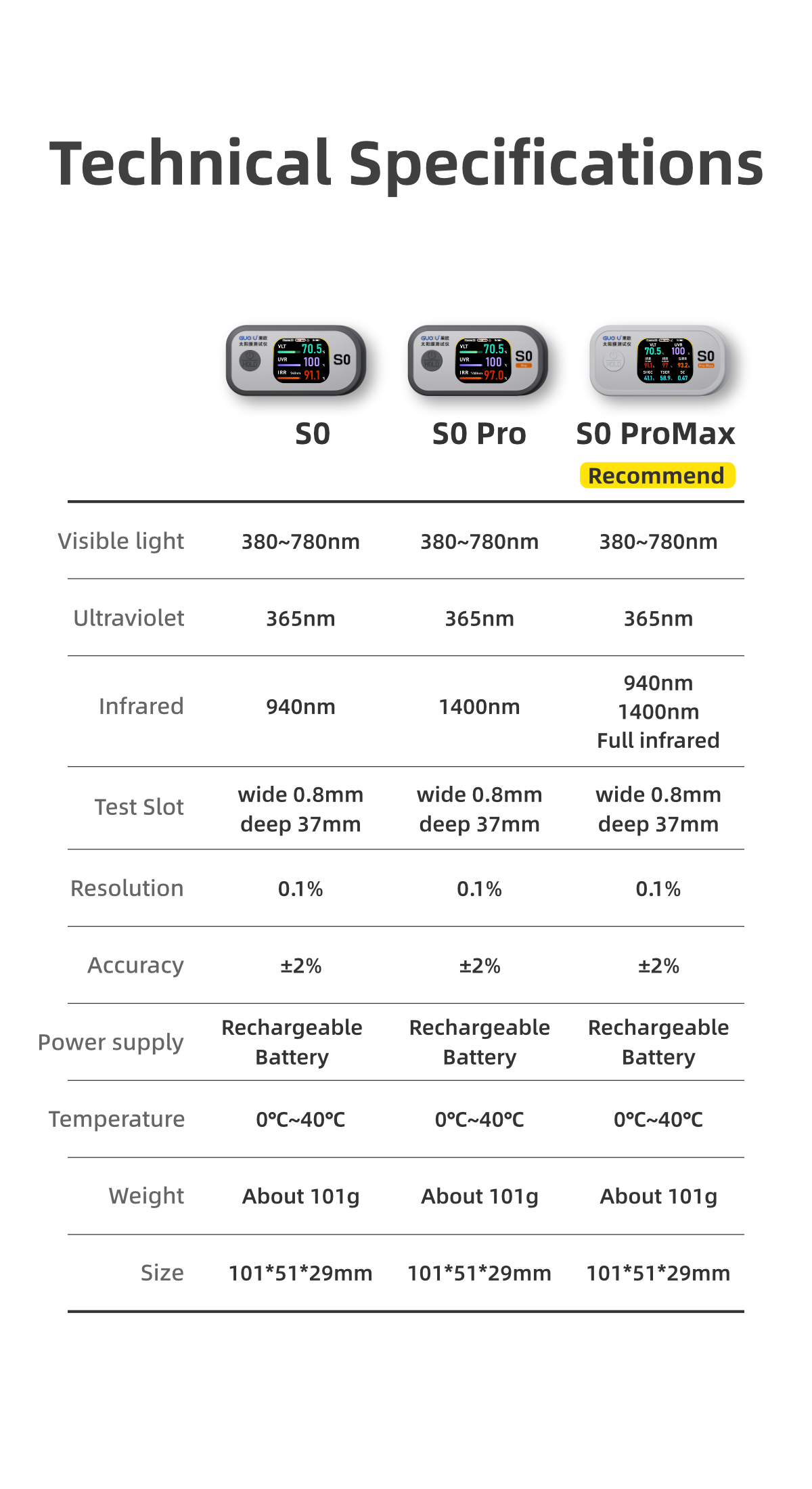
(1) Accurate Detection: ±2% detection accuracy, 0.1% resolution, ensuring each parameter is true and reliable;
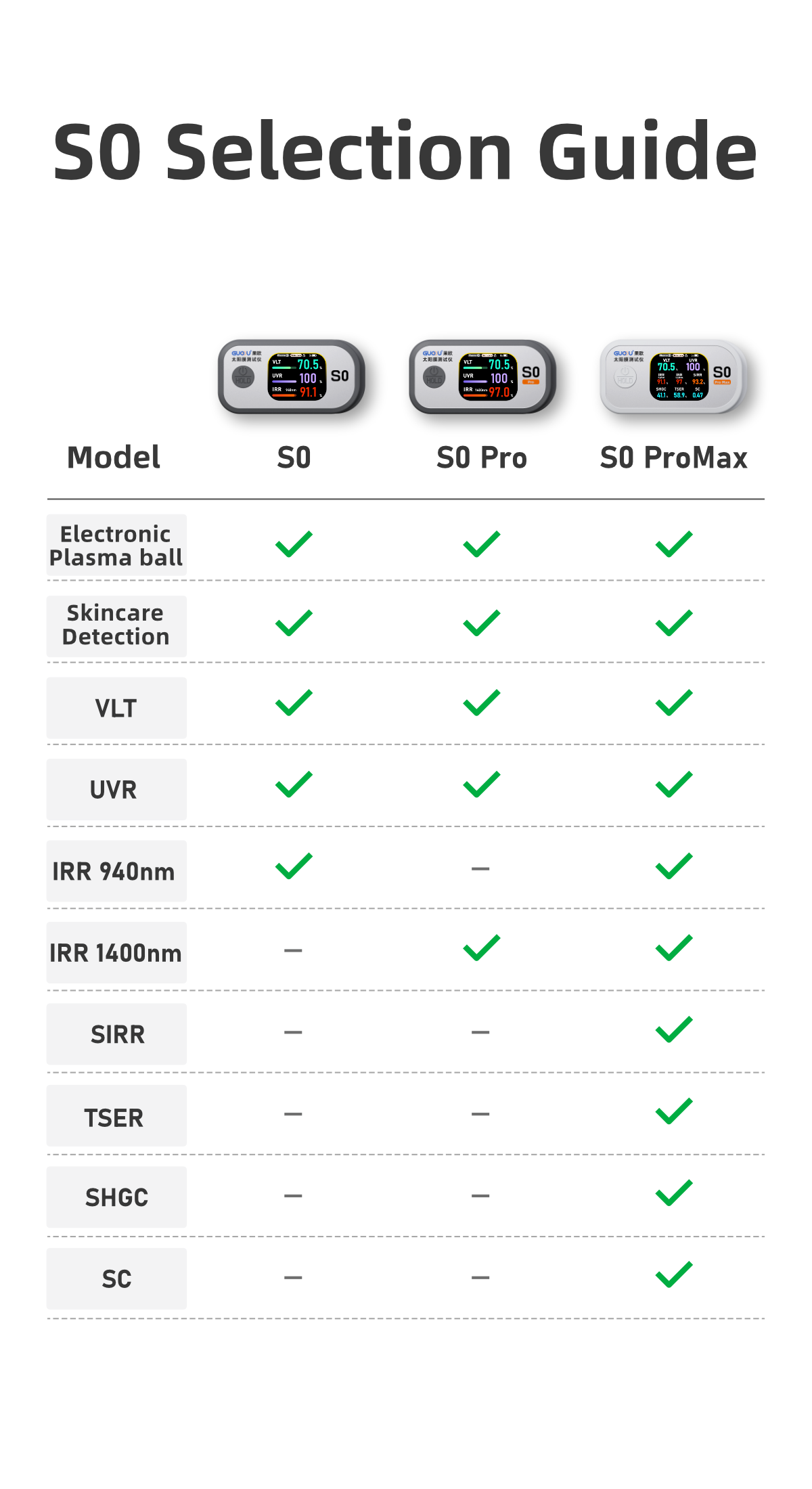
(2) Multi-mode Display: 6 display modes can be freely switched, beginners can view single parameters, and professional scenarios can view all 8 items;
(3) Portable and Easy to Use: 101g lightweight design, 37mm deepened test slot suitable for various films, 180° rotating screen for easier reading;
(4) Long Battery Life: 15 hours full-load runtime, supports working while charging, meeting high-intensity detection needs.
III. Common Misunderstanding Reminders
1. Misunderstanding: Is IRR=100% the best?
Correct Answer: Excessively high IRR may affect mobile phone signals (metal films), and VLT should be considered to ensure vision safety. 90%~97% is the golden range balancing performance and practicality.
2. Misunderstanding: Is it enough to choose film only by VLT?
Correct Answer: VLT only reflects light transmittance. Heat insulation and UV protection need to be comprehensively judged by combining parameters such as IRR, UVR, and TSER, avoiding the trap of "good light transmittance but poor heat insulation".
3. Misunderstanding: The higher the parameter value, the better?
Correct Answer: It needs to be balanced according to the usage scenario. For example, excessively low VLT of side and rear windows will affect night driving safety, and should be selected on demand rather than blindly pursuing extreme values.
Mastering the parameter interpretation method of the solar film tester can easily see through the "false propaganda" of inferior films and accurately select high-quality products suitable for yourself. The GUOOU S0 Series Solar Film Tester, supported by professional data, makes every performance clearly verifiable. Whether it is personal film selection or commercial promotion, it can be your "performance identification artifact"!