1. Basic Understanding of Ultraviolet (UV) Spectrum
Ultraviolet (UV) light is invisible electromagnetic radiation with a wavelength of 10nm-400nm, divided into UVC (100nm-280nm), UVB (280nm-320nm) and UVA (320nm-400nm). UVC is fully absorbed by the atmosphere, about 90% of UVB is blocked, and a small amount can cause sunburn; UVA has a penetration rate of over 95%, accelerating skin aging and interior fading, making it the core of protection.
Both 365nm and 400nm belong to the UVA band. Due to wavelength differences, they vary significantly in energy, harmfulness and detection applications, directly determining the choice of the solar film industry.
2. Core Differences Between 365nm and 400nm UV Blocking
1. Wavelength and Energy Characteristics
365nm UV light: Located in the short-wavelength region of UVA, it has high energy density, causing stronger degradation to organic materials such as car interiors and cumulative damage to the skin. It is easily captured by protective components in solar films, with quantifiable protection effects.
400nm UV light: Close to the violet light of visible light, it has low energy. Although its penetration is slightly stronger, its harmfulness is mild, and its impact on skin and materials is much weaker than 365nm UV light.
2. Protection Targeting and Practical Value
365nm is the main harmful UVA wavelength in daily environments. The blocking rate of solar films against it directly determines protection performance, and a blocking rate of ≥99% is a core indicator of high-end products. 400nm is not a key protection focus, and excessively high blocking rate may affect visible light transmittance and interfere with driving vision.
3. Detection Standards and Instrument Compatibility
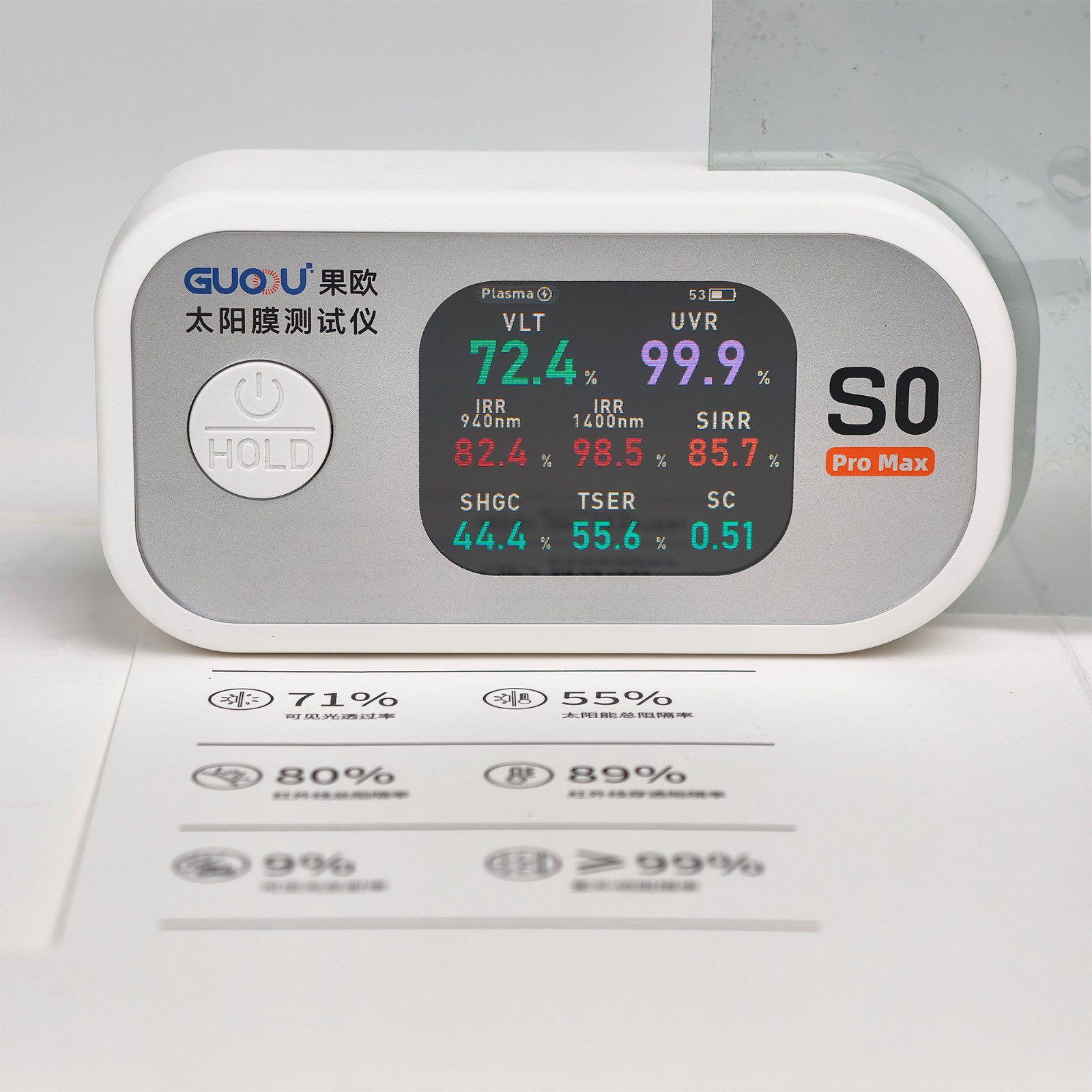
Standards such as ISO 13837:2008 and GB/T 30184-2013 all take 365nm as the core test wavelength. Guoou Solar Film Transmission Meter complies with this standard, with 365nm as the peak UV test wavelength, which can directly and accurately display the blocking rate. Equipped with a parallel optical path design, the test data is not affected by the sample placement position, providing stable and reliable detection support for the industry.
There is no unified detection standard for 400nm, resulting in limited application scenarios. Only special products will additionally mark their blocking performance.
3. Why is 365nm UV Blocking Standard Widely Adopted in the Market?
1. Aligns with Practical Protection Needs and Has Stronger Targeting
The energy and penetration characteristics of 365nm UV light make it the core target of solar film protection. Focusing on its blocking rate can accurately meet consumers' needs for skin health and interior protection.
2. Complies with Industry Standards and Has Unified Comparability
International and domestic standards all take 365nm as the test benchmark. Mainstream equipment such as Guoou Solar Film Transmission Meter is also compatible with this wavelength, ensuring standardized and comparable product data, helping consumers quickly judge quality and promoting healthy competition in the industry.
3. Mature Technology and Controllable Testing Costs
The blocking technology for 365nm is mature, making it easy for manufacturers to achieve high blocking rates with controllable costs. Guoou Solar Film Transmission Meter is easy to operate, fast in measurement, and has a real-time self-calibration function, suitable for production, quality inspection, exhibitions and other scenarios, greatly reducing the industry's testing threshold.
Due to the lack of unified standards for 400nm, there are few testing equipment and technical applications, which will increase manufacturers' costs and make it difficult to form industry consensus.
4. Avoids Conflicts Between Performance and Experience
365nm is significantly separated from the visible light band, and high blocking rate will not affect the field of vision; 400nm is close to visible light, and excessively high blocking rate is likely to cause glass discoloration and affect driving comfort, which is also a key reason why manufacturers prefer 365nm.

4. Conclusion
365nm and 400nm differ significantly in harmfulness and industry applications. 365nm has become the mainstream due to its alignment with needs, compliance with standards and mature technology. With equipment such as Guoou Solar Film Transmission Meter that accurately adapts to 365nm wavelength, the protection performance of solar films can be efficiently quantified, providing reliable basis for consumers, manufacturers and testing institutions.